Tablespoon to Grams: Flour Conversion Guide (Plain, All-Purpose & UK Flour)
1 tablespoon of plain or all-purpose flour weighs about 8 grams when spooned and leveled. Scooped flour weighs up to 25% more. Charts, UK vs US flour, and a calculator.
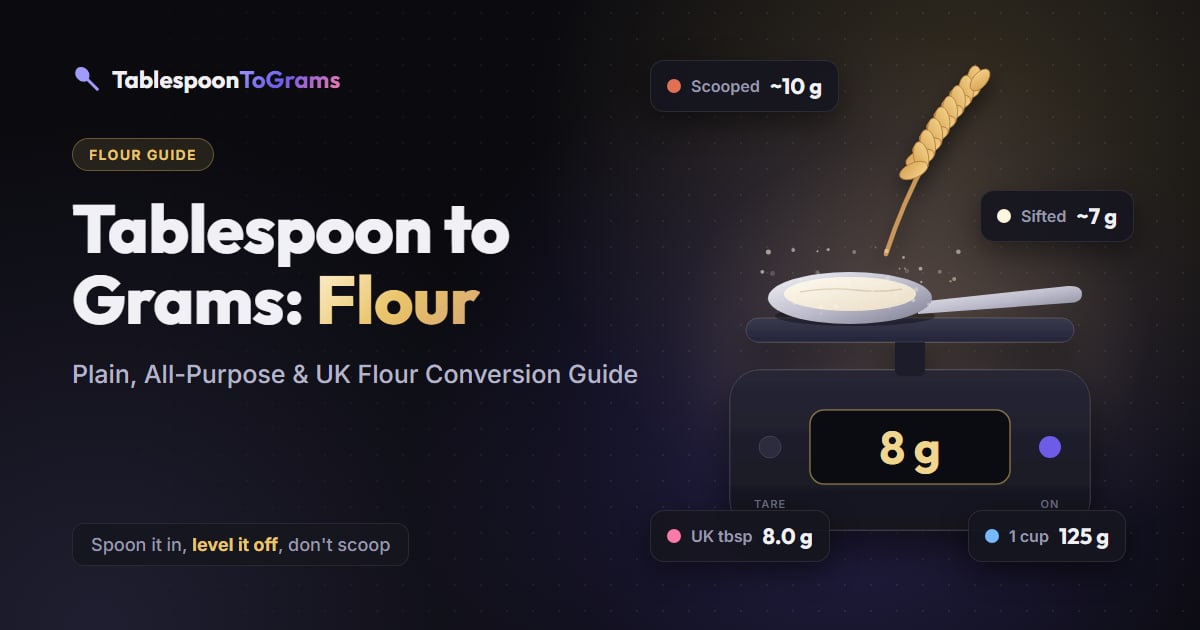
Quick answer: 1 tablespoon of flour = 8 grams
1 tablespoon of plain or all-purpose flour weighs about 8 grams. That’s 7.8 g in a US tablespoon and 8.0 g in a 15 ml UK tablespoon.
But that number only holds if you measure the right way: spoon the flour in, then level it off. How you fill the spoon changes the weight more than anything else:
- Spooned and leveled: 7.8 g
- Scooped from the bag: up to 10 g
- Sifted: about 7 g
Pick your flour, how you measured it, and your tablespoon size in the calculator below.
Flour Converter
6 items · Density varies by itemWhy flour weight varies so much
Flour is a fine powder full of air. How much air depends on what happened to it last.
Flour sitting in a bag settles. The weight of the flour above presses the flour below into a denser layer. Stir it or spoon it and you shake air back in. Sift it and you add even more.
Think of snow. A shovel of fresh, fluffy snow is light. Pack that same snow into a snowball and the same space holds far more of it. Flour behaves the same way.
So when you push a tablespoon into a bag of flour, you’re packing the flour into the spoon. That spoonful can weigh 20–30% more than a spoonful that was loosely spooned in and leveled.
Sugar doesn’t do this much. Its crystals are hard and don’t squash together. Salt doesn’t either. Flour is the one baking ingredient where the measuring method can throw the weight off by a quarter. That’s why most confusion about “tablespoon to grams flour” comes down to method, not math.
Flour tablespoon to grams table by type
These values are for a level tablespoon, spooned in, unless the row says otherwise.
| Flour | US tbsp (14.8 ml) | UK / metric tbsp (15 ml) | Australian tbsp (20 ml) |
|---|---|---|---|
| Plain / all-purpose, spooned and leveled | 7.8 g | 8.0 g | 10.6 g |
| Plain / all-purpose, scooped | ~9.8 g | ~9.9 g | ~13.2 g |
| Plain / all-purpose, sifted | ~6.9 g | ~7.1 g | ~9.4 g |
| Self-raising (self-rising) | ~7.8 g | ~8.0 g | ~10.6 g |
| Bread flour (UK: strong flour) | ~8.3 g | ~8.4 g | ~11.2 g |
| Whole wheat (UK: wholemeal) | ~7.5 g | ~7.7 g | ~10.2 g |
| UK plain flour | 7.8 g | 8.0 g | 10.6 g |
USDA’s FoodData Central puts a cup of all-purpose flour at 125 g, which works out to 7.8 g per tablespoon. That matches the first row. Rows marked with ~ are close estimates. Brands differ a little.
A few notes on each flour:
- Plain and all-purpose are the UK and US names for the same everyday flour. Per spoon, they weigh the same.
- Self-raising flour is plain flour with baking powder mixed in. US self-rising flour has salt too. The extra few percent doesn’t change the weight per spoon.
- Bread flour has more protein. It’s a touch heavier per spoon than plain flour.
- Whole wheat contains the bran, which makes it coarser. Spooned loosely, it weighs a little less per spoon than plain flour.
Spooned vs. scooped vs. sifted: which number to trust
The right number depends on how the recipe writer measured. Here’s how to match your method to the table.
Spoon and level (7.8 g per US tbsp). Stir the flour in the bag to loosen it. Spoon it into the measuring spoon until it mounds over the top. Scrape it flat with the back of a knife. This is the method most recipe writers expect, and it gives the 7.8 g in the table.
Scoop and sweep (about 10 g per tbsp). Dip the spoon into the bag, pull it out full, and level it. Fast and common, but it packs the flour. Some US test kitchens build their recipes this way. America’s Test Kitchen, for example, counts a cup of all-purpose flour as 5 oz, or 142 g. King Arthur Baking counts it as 120 g. That’s a 22 g gap per cup between two respected sources.
Sifted (about 7 g per tbsp). Flour pushed through a sieve or sifter before measuring. Watch the wording:
- “1 tbsp flour, sifted” means measure first, then sift.
- “1 tbsp sifted flour” means sift first, then measure. This gives less flour.
The simple rule: if the recipe gives grams, use grams. It removes the guesswork. If it only gives spoons or cups, spoon and level unless the recipe says otherwise.
Tablespoon to grams flour chart: 1 to 8 tbsp
| Tablespoons | Spooned (US) | Spooned (UK / metric) | Scooped (US) | Sifted (US) |
|---|---|---|---|---|
| 1 tbsp | 7.8 g | 8.0 g | 9.8 g | 6.9 g |
| 2 tbsp | 15.7 g | 15.9 g | 19.5 g | 13.9 g |
| 3 tbsp | 23.5 g | 23.9 g | 29.3 g | 20.8 g |
| 4 tbsp (¼ cup) | 31.3 g | 31.8 g | 39.0 g | 27.8 g |
| 5 tbsp | 39.2 g | 39.8 g | 48.8 g | 34.7 g |
| 6 tbsp | 47.0 g | 47.7 g | 58.6 g | 41.7 g |
| 8 tbsp (½ cup) | 62.7 g | 63.6 g | 78.1 g | 55.6 g |
So 3 tablespoons of flour is about 24 g, and 6 tablespoons is about 47 g, spooned and leveled.
For any other amount, multiply the tablespoons by 7.8 (US) or 8 (UK). To go from grams to tablespoons, divide: 25 g of flour is about 3.2 US tablespoons, and 50 g is about 6.4.
US vs UK flour measuring habits
UK recipes list flour in grams. A British cake recipe says “225 g self-raising flour,” and you weigh it. Spoons show up only for small amounts, like a tablespoon of flour to thicken gravy or dust a tin.
US recipes list flour in cups and tablespoons. Most American home bakers measure by volume, and many don’t own a scale.
That mismatch explains a lot of searches. A UK baker following an American recipe needs to turn “3 tablespoons of flour” into grams. A US baker using a British recipe needs to do the reverse.
The spoons are close in size. A UK tablespoon holds 15 ml. A US tablespoon holds 14.79 ml, set by NIST as half a US fluid ounce. For flour, that’s 8.0 g against 7.8 g, a gap you’ll never notice.
Australia is different. An Australian tablespoon holds 20 ml, so a tablespoon of flour there weighs about 10.6 g. If an Australian recipe calls for 2 tablespoons of flour, that’s 21 g, not 16 g. See the Australian tablespoon converter for other ingredients.
UK and US flour names differ too:
- Plain flour (UK) = all-purpose flour (US)
- Self-raising flour (UK) = self-rising flour (US)
- Strong flour (UK) = bread flour (US)
- Wholemeal flour (UK) = whole wheat flour (US)
The baking mistake scooped flour causes
Too much flour is one of the most common reasons homemade cakes come out dense and dry. And scooping is the usual cause.
Scooping adds about 2 g per tablespoon. That sounds small. Over a cup, it’s about 30 g. A cake that calls for 3 cups can end up with 75–95 g of extra flour. That’s close to ¾ of a cup the recipe never asked for.
Here’s what extra flour does:
- Cakes come out dense, dry and crumbly.
- Cookies don’t spread. They bake up thick, pale and cakey.
- Bread dough turns stiff and rises poorly.
- Sauces and gravy thicken into paste.
If your bakes keep coming out dry, check how you measure flour before you blame the recipe. Weighing on a kitchen scale is the surest fix. If you don’t have one, spoon and level every time.
Frequently asked questions
How many grams is 1 tablespoon of flour?
1 tablespoon of plain or all-purpose flour weighs about 8 g when you spoon it in and level it off. That's 7.8 g in a US spoon and 8.0 g in a 15 ml UK spoon. If you scoop the spoon straight into the bag, it can weigh close to 10 g. Sifted flour weighs about 7 g.
Is UK flour the same weight as US flour per tablespoon?
Close enough to treat them the same. UK plain flour and US all-purpose flour weigh about the same per spoonful. The small gap comes from the spoon: a 15 ml UK tablespoon holds 8.0 g of flour, and a 14.8 ml US tablespoon holds 7.8 g.
How many grams is 3 tablespoons of flour?
3 tablespoons of plain or all-purpose flour weigh about 24 g, spooned and leveled. That's 23.5 g with US tablespoons and 23.9 g with 15 ml UK tablespoons. Scooped, 3 tablespoons can weigh close to 30 g.
More tablespoon to grams conversions
- Flour tablespoon to grams calculator: converter, formula and full conversion table for all-purpose flour.
- How many grams are in a tablespoon?: the full guide for water, salt, oil, cocoa and more.
- Butter tablespoon to grams (US, UK & Australia): charts for 1 to 9 tbsp and US butter sticks.
- Sugar tablespoon to grams (white, brown & powdered): packed brown sugar, icing sugar and more.
- Honey, maple syrup & golden syrup tablespoon to grams: sticky syrups and the honey-for-sugar swap.
- Yeast tablespoon to grams (dry & instant): packets, teaspoons and fresh yeast swaps.
- Tablespoon to grams calculator: convert 35 ingredients both ways.