How Many Grams Are in a Tablespoon? (Full Conversion Guide + Calculator)
1 tablespoon of water weighs 15 grams. See grams per tablespoon for butter, sugar, flour, honey and more, with charts, regional spoon sizes and a free calculator.
Quick answer: how many grams in 1 tablespoon?
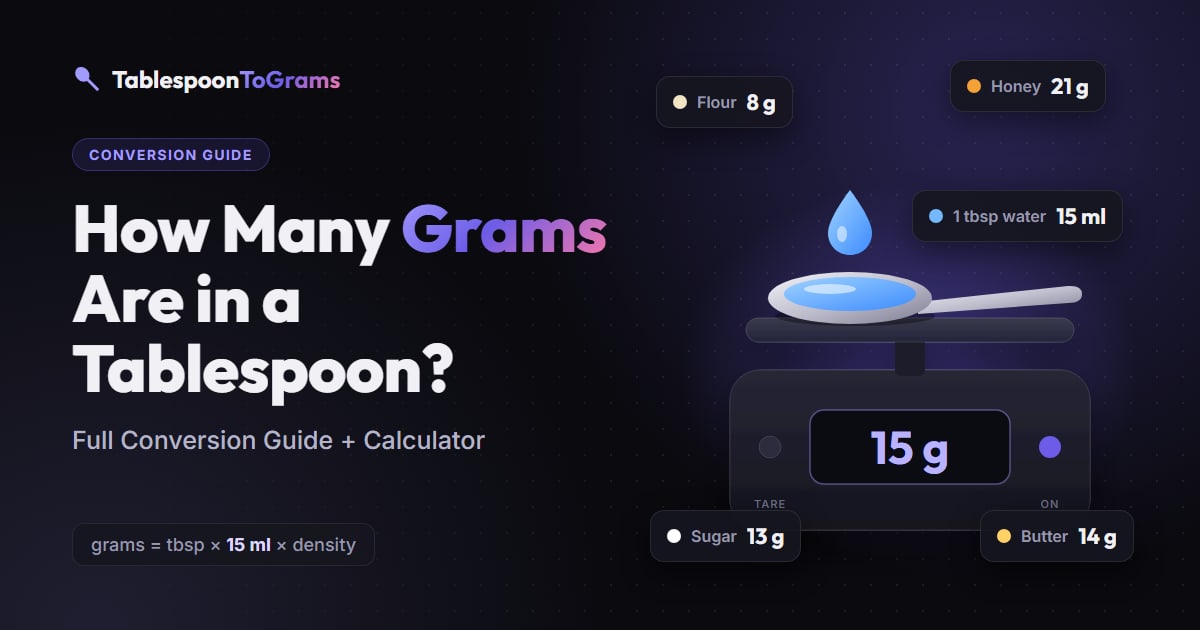
1 tablespoon of water weighs 15 grams. A US tablespoon holds a little less (14.8 ml), so it weighs 14.8 g.
That number works for water and for liquids of similar weight, like milk, vinegar and lemon juice. It doesn’t work for most other ingredients. Here’s what one level tablespoon weighs for five kitchen staples:
- 1 tbsp water = 15 g
- 1 tbsp butter = 14 g
- 1 tbsp granulated sugar = 13 g
- 1 tbsp all-purpose flour = 8 g
- 1 tbsp honey = 21 g
Same spoon. Very different weights. Pick your ingredient in the tablespoon to grams calculator below to get the exact figure.
Tablespoon to Grams Converter
Tablespoon = 15 ml · 3 teaspoonsWhy a tablespoon doesn’t always equal 15 grams
A tablespoon measures volume: how much space something takes up. A gram measures mass: how heavy it is. You can’t turn one into the other without a third number, the ingredient’s density.
Density tells you how many grams fit into one milliliter. Water sits at 1 g/ml, which is why 15 ml of water weighs 15 g. Flour is light and full of air, about 0.53 g/ml. Honey is thick and heavy, about 1.42 g/ml.
Think of a tablespoon as a tiny box. Fill it with feathers and it weighs almost nothing. Fill it with sand and it gets heavy. The box stays the same. What goes inside changes the weight.
The tablespoon to grams formula
grams = tablespoons × ml per tablespoon × density (g/ml)
Two examples with a 15 ml tablespoon:
- Flour: 1 × 15 × 0.53 = 7.95 g, so about 8 g
- Honey: 1 × 15 × 1.42 = 21.3 g, so about 21 g
Honey weighs more than 2.5 times as much as flour in the same spoon. That’s why bakers weigh flour on a kitchen scale instead of trusting a measuring spoon.
To convert the other way, from grams to tablespoons, divide:
tablespoons = grams ÷ (ml per tablespoon × density)
So 100 g of sugar is 100 ÷ (15 × 0.85) = about 7.8 tablespoons.
Tablespoon sizes by country: US, UK, Australia, NZ and Europe
Not every tablespoon is the same size. Most of the world uses the 15 ml metric tablespoon. The US customary system uses a slightly smaller spoon. Australia uses a bigger one.
| Country or system | 1 tablespoon (ml) | 1 tbsp of water (g) |
|---|---|---|
| United States | 14.8 | 14.8 |
| United Kingdom (modern) | 15 | 15 |
| United Kingdom (old imperial) | 17.8 | 17.8 |
| Australia | 20 | 20 |
| New Zealand | 15 | 15 |
| Canada | 15 | 15 |
| Europe (metric) | 15 | 15 |
| US nutrition labels (FDA) | 15 | 15 |
The US figure comes from NIST, the National Institute of Standards and Technology. It defines the US tablespoon as half a US fluid ounce, or 14.7868 ml. The FDA rounds that to 15 ml for nutrition labeling. So when a US food label lists grams “per tablespoon,” it’s based on 15 ml.
The gap between a US and UK tablespoon is about 1.5%. You won’t taste it.
Australia is the one to watch. An Australian tablespoon holds 20 ml, or 4 teaspoons instead of 3. That’s about a third more than a US spoon. Follow an Australian recipe with a US spoon and every tablespoon comes up short. With salt, baking powder or yeast, that shows in the result.
Older British cookbooks may use the imperial tablespoon of about 17.8 ml. If a recipe looks old and the quantities seem off, that’s a likely reason.
Tablespoon to grams conversion chart by ingredient
The table below gives grams per level tablespoon for common ingredients. The first column uses the 15 ml metric tablespoon. The second uses the 14.8 ml US tablespoon. Click an ingredient for its own guide or converter, with a full conversion table.
| Ingredient | Density (g/ml) | Metric tbsp (15 ml) | US tbsp (14.8 ml) |
|---|---|---|---|
| Water | 1.00 | 15.0 g | 14.8 g |
| Butter | 0.96 | 14.4 g | 14.2 g |
| Granulated sugar | 0.85 | 12.8 g | 12.6 g |
| All-purpose flour | 0.53 | 8.0 g | 7.8 g |
| Honey | 1.42 | 21.3 g | 21.0 g |
| Vegetable oil | 0.92 | 13.8 g | 13.6 g |
| Milk | 1.03 | 15.5 g | 15.2 g |
| Table salt | 1.22 | 18.3 g | 18.0 g |
| Cocoa powder | 0.52 | 7.8 g | 7.7 g |
| Active dry yeast | 0.68 | 10.2 g | 10.1 g |
These line up with USDA data. USDA’s FoodData Central lists 1 tablespoon of butter at 14.2 g and 1 tablespoon of honey at 21 g, the same as the US column.
A few things shift the numbers:
- Liquid ingredients stay consistent. Water, milk and oil fill the spoon the same way every time.
- Dry ingredients vary. Scooped flour packs down and weighs more than spooned flour. Sifted flour weighs less.
- Salt depends on the grain. Coarse kosher salt can weigh as little as half as much as fine table salt per spoon. Check the brand.
- Sugar depends on the type. Powdered sugar is about 8.4 g per tablespoon. Packed brown sugar is about 14 g.
Need something not listed? The full list of tablespoon to grams converters covers baking powder, baking soda, vanilla extract, jam, yogurt and more.
Level vs. rounded vs. heaped tablespoon
When a recipe says “1 tbsp,” it means a level tablespoon: filled, then scraped flat across the rim. Every chart on this page assumes a level spoon.
Two other versions show up in recipes, mostly British ones:
- Rounded tablespoon: a small dome above the rim. About 20–30% more than level.
- Heaped tablespoon: as much as the spoon will hold. About 50% more than level, and sometimes close to double for light powders like flour or cocoa.
Here’s roughly how that changes the grams:
| Ingredient | Level tbsp | Rounded tbsp (~+25%) | Heaped tbsp (~+50%) |
|---|---|---|---|
| All-purpose flour | 8 g | 10 g | 12 g |
| Granulated sugar | 13 g | 16 g | 19 g |
| Cocoa powder | 8 g | 10 g | 12 g |
| Table salt | 18 g | 23 g | 27 g |
| Active dry yeast | 10 g | 13 g | 15 g |
Treat these as estimates. No two people heap a spoon the same way. A recipe that asks for a heaped tablespoon is usually forgiving, like a soup, stew or porridge. For baking, stick with level spoons or a scale.
Liquids can’t be heaped. Butter and honey rarely are.
Tablespoon to grams chart: 1 to 8 tablespoons
For quick lookups, here are the most common amounts. Butter, sugar and flour use 15 ml tablespoons, rounded to the nearest gram.
| Tablespoons | Water (15 ml) | Water (US 14.8 ml) | Butter | Sugar | Flour |
|---|---|---|---|---|---|
| 1 tbsp | 15 g | 14.8 g | 14 g | 13 g | 8 g |
| 2 tbsp | 30 g | 29.6 g | 29 g | 26 g | 16 g |
| 3 tbsp | 45 g | 44.4 g | 43 g | 38 g | 24 g |
| 4 tbsp (¼ cup) | 60 g | 59.1 g | 58 g | 51 g | 32 g |
| 6 tbsp | 90 g | 88.7 g | 86 g | 77 g | 48 g |
| 8 tbsp (½ cup) | 120 g | 118.3 g | 115 g | 102 g | 64 g |
In the US, 8 tablespoons of butter is one stick, and the wrapper lists it as 113 g.
For any other number, multiply the 1 tablespoon value. 5 tablespoons of sugar is 5 × 12.75 = about 64 g. 12 tablespoons of water is 12 × 15 = 180 g. And 16 tablespoons make one cup.
How to measure tablespoons without a scale
A kitchen scale gives the most accurate result. But a measuring spoon gets you close if you use it well.
- Use a real measuring spoon. The big spoons in your cutlery drawer vary a lot in size. A measuring spoon is marked “1 tbsp” or “15 ml.”
- Spoon and scrape dry ingredients. Don’t dig the spoon into the flour bag. That packs the flour and adds weight. Stir the flour to loosen it, spoon it in until it overflows, then scrape it flat with the back of a knife.
- Keep powders loose. Flour, cocoa and powdered sugar should never be pressed down. Brown sugar is the exception. Recipes expect it packed firmly.
- Fill liquids to the brim. Hold the spoon level and fill until the liquid sits flush with the rim. Do it over a small cup, not your mixing bowl, so spills don’t end up in the batter.
- Oil the spoon for honey and syrup. A thin film of oil lets sticky liquids slide right out instead of leaving a gram or two behind.
- Use the butter wrapper. US butter sticks have tablespoon marks printed on the paper. Cut along the lines. Each mark is about 14 g.
If you get a scale later, test your spoons once. One level tablespoon of water should read 15 g, or 14.8 g for a US spoon. If it reads far off, your spoon isn’t standard.
Frequently asked questions
Is 1 tablespoon always 15 grams?
No. A tablespoon always holds about 15 ml, but the weight depends on what fills it. Water weighs 15 g per tablespoon. Flour weighs about 8 g, sugar about 13 g, butter about 14 g and honey about 21 g. The 15 g figure only holds for water and liquids close to water, like milk or vinegar.
How many grams is 8 tablespoons?
8 tablespoons of water weigh 120 g, or 118 g with US tablespoons. 8 tbsp of butter weighs about 115 g (a US stick is 113 g), 8 tbsp of granulated sugar about 102 g, and 8 tbsp of all-purpose flour about 64 g. 8 tablespoons equal half a cup.
What's the difference between a US and UK tablespoon?
A US tablespoon holds 14.8 ml. A modern UK tablespoon holds 15 ml. The gap is about 1.5%, too small to change a recipe. Older British cookbooks may use the imperial tablespoon of about 17.8 ml. Australia uses a bigger 20 ml tablespoon, about a third larger than the US spoon.
Convert tablespoons to grams for any ingredient
Skip the math. The tablespoon to grams calculator converts 35 ingredients both ways, from tbsp to g and from grams to tablespoons, and shows the formula for each result.
For a single ingredient, these guides include a converter, a conversion table and answers to common questions:
- Butter tablespoon to grams (US, UK & Australia)
- Sugar tablespoon to grams (white, brown & powdered)
- Flour tablespoon to grams (plain, all-purpose & UK flour)
- Honey, maple syrup & golden syrup tablespoon to grams
- Water, milk & oil tablespoon to grams
- Salt tablespoon to grams
- Yeast tablespoon to grams (dry & instant)
- Baking powder tablespoon to grams
- Australian tablespoon to grams
- All tablespoon to grams converters